
Challenge Accepted: Improving Our Feedback Part 2
The Framework

To recap Tuesday’s piece, ensuring that administrators have the proper knowledge to evaluate instruction is a responsibility that school districts need to take on. We also need to determine if the tool we’re using to provide instructional feedback is diagnostic in nature. I understand that we still need to have a rubric to evaluate teaching, and we can’t wait for new frameworks to be created before continuing to evaluate instruction. For many districts, this means that they need to continue to use the Danielson Framework for formal observations. That said, there are things that districts could do in order to more accurately evaluate teaching using this framework. For example, district leaders could analyze the rubric and look for where it might make sense to add the phrase “As a result of teacher actions.” Looking at what’s written in the framework, we see “Students take initiative in using instructional materials and resources by adapting them appropriately for their own needs” for domain 3c. I might consider adding that phrase here so it reads, “As a result of teacher actions, students take initiative…” While there’s a slight contradiction here (if teachers are driving the work, did students take the initiative?), the phrase more accurately reflects what happens in the classroom. For other instances, we might simply make the proficient description what qualifies as distinguished. Let’s revisit what’s included for 3e:
Proficient: The teacher effectively adjusts learning experiences based on real-time evidence and students’ individual and specific needs.
Distinguished: Students voice their needs and assume responsibility for their own learning by making necessary adjustments to the learning experiences with the support and encouragement of the teacher.
My critique here is that if a teacher asks a diagnostic question with very targeted distractors and then bases her next instructional move on students’ responses, that’s a distinguished characteristic. That’s exactly the type of instruction that I want my own kids to experience. Therefore, I would be happy to give this teacher a distinguished rating for this component.
But just because we may need to use that rubric for our formal observations does not mean that we need to use the same one for our day-to-day feedback. For that, I would use something that better aligns to how people learn. A little over a year ago, I was introduced to a platform called Steplab. If you haven’t heard of it, you should definitely check it out. Contact Learning Science Design and see if he can give you a quick tour. The framework that they use is called the Simple Model of Teaching. I love this because it’s aligned to how people learn, and you can use it to diagnose where learning is breaking down so that you’re able to identify ways to improve instruction. Each idea in this model is referred to as a fundamental learning problem. They include:
Create culture
Secure attention
Optimize communication
Drive thought
Gather & give feedback
Ensure consolidation
The fundamental learning problems are sequential, meaning that before we can address driving thought, we need to make sure that we’re getting, keeping, and directing students’ attention. It doesn’t matter how you’re getting students to think if they’re thinking about the wrong things. Similarly, before we attempt to gather feedback to determine understanding, we need to make sure that our explanation, or communication, was clear and understandable.
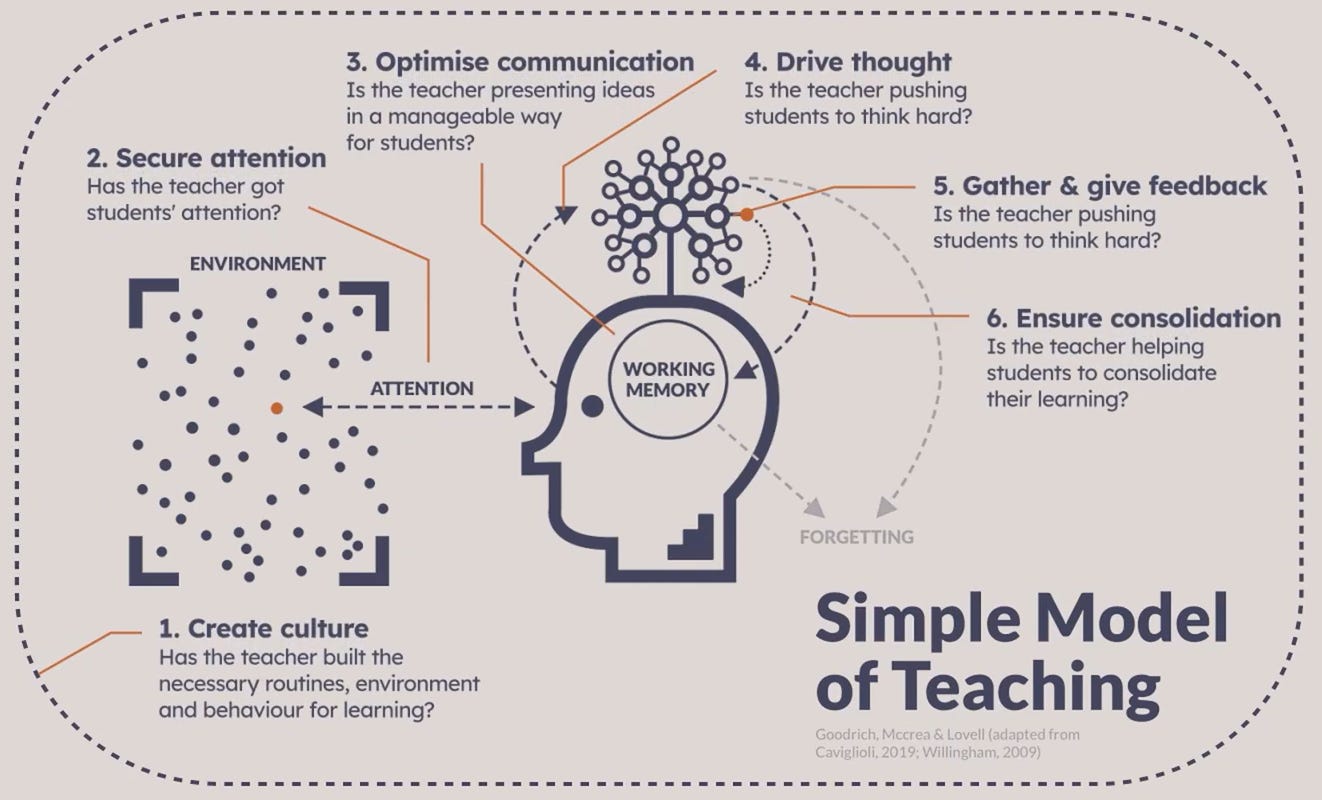
While it’s not shown on this graphic, the work starts before students enter the room with curriculum and planning. Nothing we do with the students matters if we haven’t planned to present the right information. This means that before we even step foot in the classroom, we have to have read our materials, determined what it is that we’re trying to teach, and planned the most efficient path to convey that information. What tasks are students going to complete? What questions will be asked to assess students’ understanding? How will the class transition from one part of the lesson to the next. These are all crucial questions that teachers need to plan for or they leave learning to chance. When we, as evaluators, notice that the tasks students are completing don’t align with the intended outcome of the lesson or that lesson goals ignore how much information students retained from previous instruction, we can provide feedback that helps teachers plan to deliver more effective instruction.
Once we’re in front of students, we need to start with creating culture. Put simply, this could be described as the way we do things here. It represents the routines classrooms (and buildings) should have in place, motivating students to learn, and how to respond to both positive and negative behavior. This is not entirely unlike Domain 2 from the Danielson Framework, but it focuses on intentional teacher actions instead of expecting that the students are leading the work at the highest level. Do we want them to get there? Yes. No one is arguing that. But students can only get there with appropriate teacher moves. I love my children dearly, but there have definitely been times where they act like it’s the first time they’ve ever eaten at a restaurant, which requires a conversation to reset expectations. I have a few different ways that I can handle this conversation. I can yell at them for being disruptive (which may have happened once or twice), or I can have a conversation with them on how they should behave and help them identify if what they’re doing aligns with restaurant expectations. One of those approaches is more likely to lead to better long-term outcomes. Instead of thinking that with the best parenting, my children will “play an active role in establishing and maintaining expectations,” I should probably know the moves I can make to obtain the results that I want. If the lesson was well-structured but the routines and response to behavior was off or inconsistent, then we need to focus our feedback at developing these basic processes first. Students need to be able to anticipate classroom structures so that they are better able to attend to the information that’s presented.
With the lesson plans made and routines and behaviors set, we can move to attention. If we return to Willingham’s model of the mind from one of the challenges, we see information only makes it into working memory if we pay attention to it in the first place. Teachers can give the best explanation in the world, but if students are preoccupied with how windy it is outside (as Caiti Wade mentioned), then they’re not going to learn much. But getting students’ attention isn’t enough. Teachers need to direct students’ attention to the things we want them to remember. You might have a really funny story that’s tangentially related to the topic you’re teaching, but if you’re not careful, students will end up remembering the story instead of the content. Using practices such as choral responses, checks for listening, and repeating key information will increase the likelihood that students attended to what you’ve taught. Similarly, keeping a pace that’s brisk but not too fast will defend against mind wandering. If observers notice that teachers are not getting and keeping attention or focusing it on the wrong things, then feedback can provide teachers with ideas to help secure students’ attention.
After attention, the framework moves to communication. This looks at how the teacher is communicating information. Are they providing clear and memorable explanations? Did they use modeling or worked examples in their instruction? Did they provide examples and nonexamples? How did they get out in front of misconceptions? Many of us have likely had the experience where we’re genuinely interested in learning something, but it was being presented in a manner that made understanding impossible. For example, I love history. I think learning about the past is incredibly interesting. But I took a course in college called History 141: Antiquities to 1660. The course set up didn’t allow the professor to limit new content. She didn’t have the time to link new information to prior learning. We never had processing time. When evaluators see that routines are crisp and that students are genuinely trying to attend to the content but they’re not understanding, we can provide feedback to help improve instruction. We might help teachers lean out their explanation or guide them to provide multiple and varied examples. The work here helps teachers clean up their delivery of a well-designed lesson plan.
If we’ve determined that teachers are presenting material effectively, we can then look at how they’re driving student thought. Learning happens when students have to think hard, so we need to make sure teachers are holding everyone accountable for thinking hard. Remember, quality tasks and questions were already planned before teachers got in front of students. Now that we’re in the classroom, we’re looking at how teachers are holding students accountable for completing those tasks and answering those questions. This could mean that teachers are using techniques such as cold calling, turn and talks, or think-pair-share. Teachers should be pushing students to explain their thinking by answering how and why questions. We should be looking at the opportunities students have to practice independently and if students are trying to integrate new information with what they already know through practices such as elaborative interrogation and self-explanation. If evaluators notice that teachers are providing solid explanations but they’re only ever calling on students with their hands raised, then they can provide feedback that increases the opportunities ALL students have to respond.
Now that students are being held accountable to demonstrate their understanding, evaluators can shift their focus to what the teacher is doing to provide proper feedback. If all students are writing on their mini whiteboards, is the teacher circulating to identify students she would like to have share their thinking with the class or to see what misconceptions exist? Is the praise precise and the feedback actionable? Are scaffolds provided when needed? How does the teacher respond when many students respond incorrectly to hinge questions? Craig Barton provides a great explanation for responsive teaching here, but the whole premise of being responsive relies on teachers gathering data and knowing what to do with it. Feedback to help teachers with this challenge should help them understand how to collect and respond to data appropriately.
The final fundamental learning problem is ensuring consolidation. Students may demonstrate understanding within the lesson, but all teachers have experienced students “getting it” on Monday and then the same class acting like they’ve never heard of it on Tuesday. Attempts to consolidate understanding should help students revisit prior learning through retrieval quizzes and repeating tricky concepts. If teachers treat learning as a linear experience, never revisiting previously taught material, feedback can help them determine how to most effectively incorporate prior instruction into their current plans.
You may be thinking that this framework focuses solely on the teacher and that including more student voice is important. I agree. What students say, both in response to teacher-provided questions and during opportunities to talk with peers, and student work are important pieces to this conversation. If students are asking each other what they’re supposed to do, that helps us diagnose that the learning broke down due to the teacher’s instruction, so we could provide feedback to help optimize communication. If students opt out and don’t respond to questions, then we know that we can focus on driving thought. If students demonstrate that they don’t understand but the teacher pushes onward, then we know that feedback should help them respond to student data. While paying attention to the intentional teacher moves is important, asking students what it is that they’re working on and determining student understanding through questions and work samples is still very much a part of the process.
Moving Forward
It’s not uncommon to hear things such as, “Everything we do is for the students.” Yes. At a universal level, that’s true for all employees of a school district. But as a district office administrator, I don’t work directly with students. I work with the adults who work with the students. If a teacher’s job is to use the right tools and practices to maximize student learning, then my job should be to use the right tools and practices to maximize adult learning so that they’re better able to attend to our students’ needs. The care and attention to detail that we want teachers to put into planning for students is exactly what I should be putting into the work I do with teachers and administrators. Teaching is incredibly hard, and the adults who do it deserve to experience frequent wins. That simply won’t happen if we don’t improve our observations and feedback.
But we can’t just say that we need to improve those things without doing the work. If we want to increase the likelihood that administrators see the intentional teacher moves that maximize learning, we need to point to the dates on our calendars on which we’ll provide the professional development. If we want to increase consistency in instructional feedback, then we need to provide a tool that helps us arrive at the same starting point. The knowledge and tools are available. We just have to be willing to do some work. And as long as we’re going to continue to use the Danielson to produce formal ratings, then I think looking at Domain 4 here would be appropriate:
Domain 4e: Growing and Developing Professionally
Enhancing Knowledge and Skills: The teacher is an expert and leader in understanding and continuously improving and refining their knowledge of content, pedagogy, and curriculum.
This is the descriptor for distinguished work in this component: continuously improving and refining one’s knowledge. I’ll end with the kid test. The kid test is putting everything through the lens of “Would this be good enough for my children?” If not, then I probably shouldn’t do it for someone else’s children. I hope that the administrators in my children’s district are continuously trying to refine their knowledge–that they’re on a constant quest to improve their work. If that’s what I want for my John and Evelyn, then that’s what I’ll try to do myself. And I’d love to work alongside anyone who wants to join me.