
Challenge Accepted: Using Small Groups & Effective Seatwork

The previous entry looked at the effectiveness of having small groups named as a time of day on the daily schedule. As a reminder, having a small-group rotation does not lead to more learning overall, and it may even lead to less learning for students who are not already proficient readers. That said, teaching students in small groups is likely going to remain a necessary evil in education, so when should we use them, and how can we make this time more effective?
Using Small Groups
I will concede that some teachers may have “figured out” how to make a small-group time of day effective. I do currently and will always wonder about the opportunity cost of not using explicit whole-group instruction with targeted small groups as needed, but I’m sure that it works for some teachers in some classrooms. Similarly, there are frameworks that look promising. For example, Stephanie Stollar has frequently discussed using small groups to deliver tier 1 phonics instruction when a significant number of students are not meeting benchmarks. This instruction is delivered in a walk-to-read model in which each student at a given grade level is grouped according to specific phonics needs; however, I would like to highlight two caveats to this practice. The first is about proficiency. This model is not needed “if most of your students score at the same level on a skill” according to a valid and reliable system of assessments. The second is about conditions. This model is only recommended if “all students are working with an adult,” which means students are not working independently at literacy centers. The second point is the crux of this practice and the point I’m making in general. I’m not challenging the use of small groups when everyone is working with a teacher.
That said, small groups will also be needed in classrooms that don’t have an adult available to work with every group. What are suggestions or guidelines for those classrooms? Research has demonstrated that small groups are more effective if they target a specific skill rather than as part of a comprehensive program designed to address multiple skills (Hall & Burns, 2018). As a reminder, skills are transferable abilities. This means that small groups will be more effective when teaching transferable knowledge such as phonics, fluency, syntax, or cohesion and considerably less effective (read: not at all) when teaching things such as comprehension skills or characteristics of leveled readers.
However, these skills do not have to be taught in small group rotations. In fact, instead of having a small-group time of day, I would encourage you to teach lessons from your curriculum to your whole group and use small groups to either :
assist students who have demonstrated a need for additional support;
provide prerequisite instruction to those who may have gaps in skills or who missed previous instruction; or
practice a skill as a class.
So what might this look like?
Addressing the first use, teachers start the lesson providing whole-group instruction. If this is a phonics lesson, they would go through any phonemic awareness warm ups if that’s included and explicitly teach the new sound, reaching for 80%-85% of students being accurate when saying the sound in isolation as well as when they’re reading it in individual words and sentences. When the class moves to independent practice, teachers would be able to pull students who struggled to a teacher-directed table so that they can intensify instruction, monitor students’ progress more closely, and provide timely feedback as needed.
A lesson that’s more focused on comprehension or analyzing authors’ craft would follow a similar structure. Teachers would still start the lesson using whole-group instruction so that they could review the prior knowledge that students need for this lesson and preview essential vocabulary if that’s included in your curriculum. As soon as students moved to independent or partner reading, however, teachers could then pull students who have demonstrated a need into a group to help them overcome the challenging language structures in the piece, as discussed here. Additional questions for these students might target pronouns or substitutions to ensure students are tracking actors and actions across sentences. They might target syntactic elements to help students comprehend particularly complex sentences. Teachers might quickly define tier 3 vocabulary or prompt students to write gist statements after each paragraph. The general intent of this instruction is to help students understand how the language conveys meaning as well as to reduce the amount of reading between stopping points to lower the cognitive demands of reading the text.
Something to highlight in both of these situations is that the teacher is providing more instructional support to help those who have additional needs accomplish the same goal as the rest of the class. Whether it’s practicing new phonics skills or comprehending a passage, the instruction did not change the expectations for some of the class. This is instructional differentiation instead of content differentiation–the next topic of discussion. Both situations also provide teachers the opportunity to check on other students while the group is working on a set task.
To address the second aforementioned use for small groups, there are times where students simply don’t possess enough of the prerequisite knowledge to participate in the independent practice time of specific lessons. For example, if students are still unsure of basic grapheme-phoneme correspondences, then it likely wouldn’t make sense for them to participate in independent practice with advanced phonics skills. While it might not be the best use of their time, not having all of the prerequisite phonics skills does not automatically mean that they couldn’t participate in the whole-group lesson. As Tim Shanahan has noted multiple times, there is no single scope and sequence for phonics (2020, 2023), so students would be able to participate in the part of the lesson that introduces the new sound or sound spelling. However, it may be more appropriate for these students to spend the independent or partner practice time reading a text that they’re better able to read. Using the instructional hierarchy as a guide, the new sound presented in the whole-group lesson will fall into the acquisition stage for most students, but if too many of the sounds in the practice reader are also in the acquisition stage for some students, then reading those texts will be too much of a strain on students’ limited working memory to have any lasting positive effect on learning. It may be a better use of time for those students to read from a book that has more sounds in their fluency stage. This would mean that some students might need to read a different text during the independent or partner reading time in the lesson.
Lessons that focus on what the text says or how the text says it are a bit different from phonics instruction with this use of small groups. While it may be okay for some students to read different passages in phonics lessons (if you have data to support this decision), using different texts in comprehension lessons lowers the bar for students. What does the use of groups look like here? If the goal is to discuss author’s craft, which would typically be the second read, it may be more beneficial for students who missed the first read to simply read for meaning. It’s hard to discuss the impact of word choice or figurative language when the students don’t know what the passage is about. Similarly, when texts are to be presented in a certain sequence and students missed reading one of those texts, it might be a better use of time for them to read the piece that came first. I discussed a lesson about The Reformation in this piece. In that unit, it might be hard for students to discuss why some people believed the Catholic church needed to be reformed if they aren’t familiar with any of the Church’s common practices. In both of these scenarios, it may be more beneficial for teachers to pull students who missed initial instruction into small groups to have them at least read portions from an earlier text so that they are working with the same knowledge as the rest of the class.
In both of these first two scenarios, small groups are not used as a time of day. While teachers may need to pull groups daily to incorporate these suggestions, the important distinction to make between these recommendations and having small groups as a time on the schedule is that both of them are based on student data. Groups are used as a tool rather than a feature.
The final use of a small-group time would be to practice a skill as a class. Fluency practice, for example, is something that teachers can either set aside as a separate time of day or build directly into their tier one instruction. If fluency is a separate time of day, teachers might choose to use the PALS structure, as Dr. Matt Burns describes here. Pairing students and finding appropriate texts would take some additional effort in this scenario, but the research shows that it has a strong positive effect for all readers, even the ones who were already proficient. But teachers do not have to follow structures such as this one. In fact, Tim Shanahan frequently recommends that students read texts that are at a frustrational level, which runs contrary to the recommendations from Dr. Burns. Therefore, teachers may have students preread the text from their curriculum or use a separate text that discusses the same topic. For over 50 years, research has demonstrated that students’ reading accuracy improves dramatically simply by allowing them to reread the text (Gonzalez & Elija, 1978; Lowell, 1969). Providing the opportunity to read a text for fluency during the first read and then for comprehension on the second or third read frees up students’ working memory to focus on what the text says or how the text says it. Regardless of if this instruction was set aside as a time of day or done as part of regular instruction, students would work in partners so that the teacher is free to move from group to group in order to listen in and provide feedback.
Effective Seatwork
Thus far, we have considered how teachers might use small groups and what that instruction might look like, but we also have to discuss seatwork. If small groups must persist as a time of day, what are students doing when they aren’t with the teacher? For guidance on what makes sense here, I’ll again go back to Shanahan: “Seatwork is like homework; it is best focused on applying what students already have learned.” What’s the support for this statement? We know from the challenge that proficient readers benefit from seatwork whereas less secure readers do not. That’s likely because they already know how to get started with this work. Since they’re not complete novices, proficient readers are able to use their preexisting knowledge and skills to help them complete the practice that seatwork can provide. This is a classic case of the Matthew Effect (Stanovich, 1986) where the rich get richer and the poor get poorer. Those who already know how to read become better readers during this time while those who struggle fall further behind. How can we prevent this?
One suggestion would be to connect the seatwork to what the students will do when meeting with the teacher. For example, students might read the passage that they’re going to read in the small group prior to meeting in the group. This first read could be with a partner to focus on fluency so that the second, the one that takes place with the teacher, could focus more on comprehension. Then when students leave the group, they might work on writing in response to the passage that they just read to consolidate their learning. This would mean that the seatwork would consist of fluency work and writing.
However, the text that students read for fluency practice does not have to be the text that they will read with the teacher. In order to make more time for reading and math, many schools are short changing science and social studies. To maximize the limited time they have for these content areas, teachers might choose to have students preread the texts presented in those content areas so it’s not completely foreign to them when those subjects are taught at a different time of day, or teachers could have students reread text the they read in a previous science or social studies lesson and complete a written response.
If we want to keep students’ attention on the text used during reading, then we might plan to help students overcome the syntactic or cohesion challenges (see here for a reminder of what those things are). A previous piece shared the following “Big Question” from one lesson in CKLA: Why did some people believe the Church needed to be reformed during the 1400s and 1500s? To help students with the challenging language structures, teachers might select a paragraph from that text that might help students answer the big question and have them complete sentence reducing, sentence combining, or cohesion analysis. Using that same lesson, teachers might select the following paragraph for these activities.
For some time, the Church had raised money by issuing certificates that could release or pardon people from penance. Penance was the punishment that the Church taught was due after a sin was confessed and forgiven. Previously, penance had to be performed before a sin was forgiven. These certificates were called indulgences. Technically, indulgences weren’t sold; they were given in exchange for donations of money. Nevertheless, the money raised by the issuing of indulgences became a huge business for the Church. Many other corrupt practices also increased, such as the ability of wealthy people to buy their way into the clergy. In the late 1400s and early 1500s, religious reformers spoke out against corrupt practices in the Church and demanded reform.
Sentence reducing involves asking students to break down one sentence into multiple simple sentences, trying to keep just one idea in each. If teachers provided the excerpt and highlighted the sentence, “In the late 1400s and early 1500s, religious reformers spoke out against corrupt practices in the Church and demanded reform,” students might down it to these sentences:
Religious reformers spoke out against the Church’s corrupt practices.
Religious reformers demanded the Church be reformed.
This happened in the late 1400s and early 1500s.
The purpose of this practice is to help students untangle particularly challenging syntax. Providing students with the time to analyze and deconstruct these sentences will increase the likelihood that they comprehend the individual sentences during the actual lesson because they were provided with the time to reread and consider how the ideas are presented.
The opposite of sentence reducing is sentence combining. This task involves asking students to combine multiple sentences into one more complex sentence. Take the following sentences for example: “Penance was the punishment that the Church taught was due after a sin was confessed and forgiven. Previously, penance had to be performed before a sin was forgiven.” After reading the paragraph and the highlighted sentences, students might combine them into one of the following sentences:
Since penance was the punishment the Church taught was due after a sin was confessed, it used to have to be performed before that sin was forgiven.
Previously, people had to perform penance, or the punishment for sinning, before a sin was forgiven.
Penance was the punishment for sinning, and for many years, it needed to be performed before the sin was forgiven.
The purpose of this activity is to have students consider how the ideas are related to one another and then consider how they could use language to show that connection. In both sentence reducing and combining, the point is not for students to get the one “right” answer that teachers wanted. Instead, they are designed to help students think deeply about the ideas presented in the text.
Cohesion analysis is more similar to sentence reducing as it attempts to help students connect actors to actions and to fill in the gaps that authors may leave for readers to fill in on their own. In this activity, students would underline or circle words and phrases in different colors or draw arrows between words that describe the same thing. Students might also fill in missing details that the author intentionally excluded to avoid redundancies. In our sample paragraph, students’ work may look something like this:
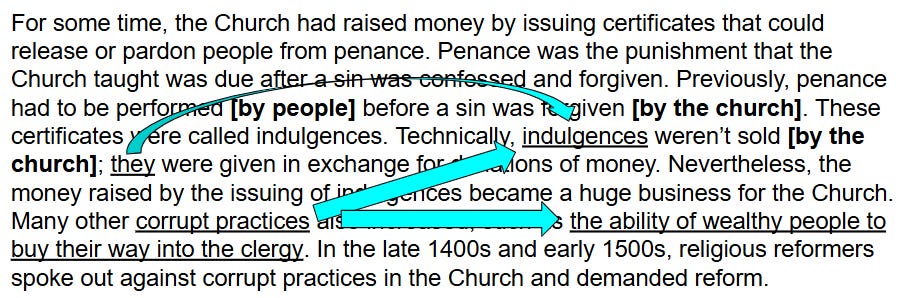
The sentence, “Previously, penance had to be performed before a sin was forgiven.” includes two ellipses that require readers to fill in missing information. Authors frequently do this to avoid redundancies, making their writing more interesting to read. We use these all of the time in day-to-day conversations as well (e.g. I asked Ben to be ready by 5. He said he would be [ready by 5].). But these can really cause issues for our struggling readers. Similarly, if students don’t realize that indulgences are the first corrupt practice that is named in the paragraph, then they would struggle to identify that it was a practice that people wanted to change. Unlike the previous two activities, cohesion analysis does require students to get the “right” answer because the purpose is to help students make connections across sentences and inferences that more proficient readers make without prompting.
Teaching students in small groups can have a tremendous impact on students’ ability to read when they’re used appropriately. But the way that many schools and districts force them as a time of day is a misrepresentation of the research, and it might increase the achievement gap that teachers are trying to close. Not only is this tragic for the students, but it’s also hard for teachers. As someone who planned for daily small-group instruction and used a variety of literacy centers, I can attest to how much work it is. Not only was it a significant lift to ensure I had materials every single day, but it was also a challenge to establish and keep routines and to continuously look at the work students completed in centers. The amount of work small-group instruction requires is likely why many refuse to accept that this time could be used better. They’ve fallen into the sunk cost fallacy, not wanting to move on to different practices because of the time, energy, and effort that they’ve already invested. But if we can set those feelings aside, we’ll find that more effective instructional approaches exist–many of which do not have to be delivered in a small group.
References
Gonzalez, P. C., & Elijah, D. (1978). Stability of error patterns on the informal reading inventory.” Reading Improvement, 15(4), 278–288.
Hall, M. S., & Burns, M. K. (2018). Meta-analysis of targeted small-group reading interventions. Journal of School Psychology, 66(Complete), 54–66.
Lowell, R. E. (1969). Problems in identifying reading levels with informal reading inventories. Paper session presented at the International Reading Association Conference, Kansas City, MO.
Stanovich, K. E. (1986). Matthew effects in reading: Some consequences of individual differences in the acquisition of literacy. Reading Research Quarter, 189(1-2), 360–407.
Love reading your pieces Ben! Keep writing! This was so good--just weighing to say that you mentioned the walk-to-read model--that's essentially what the SFA program (highlighted by Emily Hanford when she described the success in Steubenville, Ohio) does and what I can behind there is that it's very efficient. I'm pretty familiar with SFA from work that I was a part of awhile back in Baltimore. Agree with all the excellent points you've made here!
I'm a big fan of Anjanette McNeely's learning line model: https://scienceofreadingclassroom.substack.com/p/the-learning-line-an-alternative